

Posts
September 20, 2016 at 11:42AM
Day 1554: NānicāYā
The last day of Yenyaa (indrajatra) is the eight day after the Yoshin Thanegu. Dathu, the middle of Kathmandu city does not only constitute the thane-kvane dividing line but it’s also includes much more than just palace and the street.
Kumari cannot be reckoned to belong to either Thane or Kvane, her procession also takes place on the the fourth day (Chaturthi) after the full moon, this procession is also called as DathuYā. At the end of this short but wild round of central part of the city, heaps of samay baji are distributed when the virgin goddess passes Hanumandhwakha. At the end, the human embodiment of the royal goddess Taleju gives tika (mark of blessing) on the forehead of king (President, after Nepal became federal republic in 2007) to confirm his reign. (Van den Hoek: 2012)
There is also a popular story that King Jayaprakash Malla added the final day of chariot procession through the Dathu(middle) of Dathmandu city. The story has it that he did so at the wish of his Nānicā, his concubine, who lived in kilagha: quarter and could not witness the larger processions of kumari through the Thane and kvane and called it NānicāYā.
NānicāYā is the only procession which passes all the statue of Indradyo just before the end of the festival.
Picture here is of Samay Dwon from our very own celebration of YenYa in London.

September 16, 2016 at 11:42AM
Day 1550: ThaneYā - The fourth day of YenYā
The three-tiered chariot of Kumāri is taken in procession with her attendants, Ganesha and Bhairava on the fourth day of the Indrajatra. On this day, the three living deities on their respective chariot travel to the northern part of the old Kathmandu, Thane and back to Layakuli in the evening. Thane-Kvane divide can be seen in the map attached here (A.W. van den Hoek:2012)(I promise to draw a more elaborative map soon). Performing Lakhe, Pulu kishi, and Sava-bhaku lead the way of the three chariots.
The reasons to pull these chariots has been asked several times. I have always wondered what could be the need for this. One of the answers that I received from the student of architecture was to maintain the road regulations, hence people didn’t build houses on the path of these gods and goddess neglecting the space required for their chariots.
The most convincing answer that I have come across, however, is that pulling of the chariots means that gods and goddess visiting to those worshipers, who are children, too ill and/or too old who cannot visit the temples themselves. Also, in the olden days (even now, sometimes) people of certain castes were not allowed to enter into the temples, so they didn’t have the opportunity of darshan of these gods and goddess. But when the gods and goddess themselves go around the city, everybody gets an opportunity
[It is believed that ThaneYaa was the last day of the four-day-Indrajatra before Prithvi Narayan Shah conquered Nepal. The four-day Indrajatra has become an eight-day festival since the Shah rule. Gorkha King Prithvi Narayan Shah succeeded to take the power from the unfortunate last Malla King Jaya Prakash Malla on the fourth day of Indrajatra, but the people did not accept him as their king, and did not permit him to receive the blessing from the Living goddess Kumāri that was mandatory for any ruler. The negotiations went on for four days and at the end of the fourth day, Prithvi Narayan Shah received the “Tika” from the Living Goddess Kumāri and became the legitimate king. (I shall update on the reference of this as I need to make my findings for my research more concrete)]

September 15, 2016 at 11:43AM
Day 1549 : Kvane yā: - Third day of YenYaa (indraJatra)
The start of the Kumāri Yātrā takes place on the fourteenth of the bright half of the month of Bhadra, on the third day of the Indrajatra. On this day, Kumāri on her three chariot is accompanied by the two other living gods as her attendants: two young boys embodying Ganesha and Bhairava precede her chariot in their own one-tiered chariots. Ganesh and Bhairava are the common attendants of the Gana, the group of eight or nine martikas across the valley.
Kathmandu is ritually divided in between the Thane(Upper), the northern part of the town and the Kvane(Lower)m the southern part of the town. The dividing line is most often seen as the diagonal leading from the northern place gate in a north-eastern direction towards Asan Square; all areas above it belongs to Thane and the areas below it too Kvane. (Van Den Hoek: 2012)
Kvane yā is the day when the three Chariaots of Kumāri, Bhairava and Ganesha are taken in procession around Thane. Chariot of Ganesh leads the chariot of Batuk Bhairava, and then of the Kumari to the south-side of old Kathmandu, and then back to Layakuli. Performers of Lakhe, Pulu kishi, and Sawa-bhaku dances go ahead of the chariots performing dances on the way. (More on Ganesha, Bhairava, Lakhe, Pulu kisi, sawa-bhakhu to follow)
In the night, Dāgī (Indra’s mother) goes around looking for her son Indra that had come to earth to pick a flower called ‘pārijāt’ for his mother Dāgī. Sons and spouses of the deceased during the year follow Dāgī hoping to go to the heaven with Dāgī to meet their loved ones.
A series of oil lamps set on bamboos called ‘Bau-mata’ is taken around the town following the route of Dāgī apparently for giving the light to Dāgī on her way. (Story of Dāgī to follow)
September 13, 2016 at 11:45AM
Day 1547: YenYaa - Indrajatra
Yahsim Thanigu:
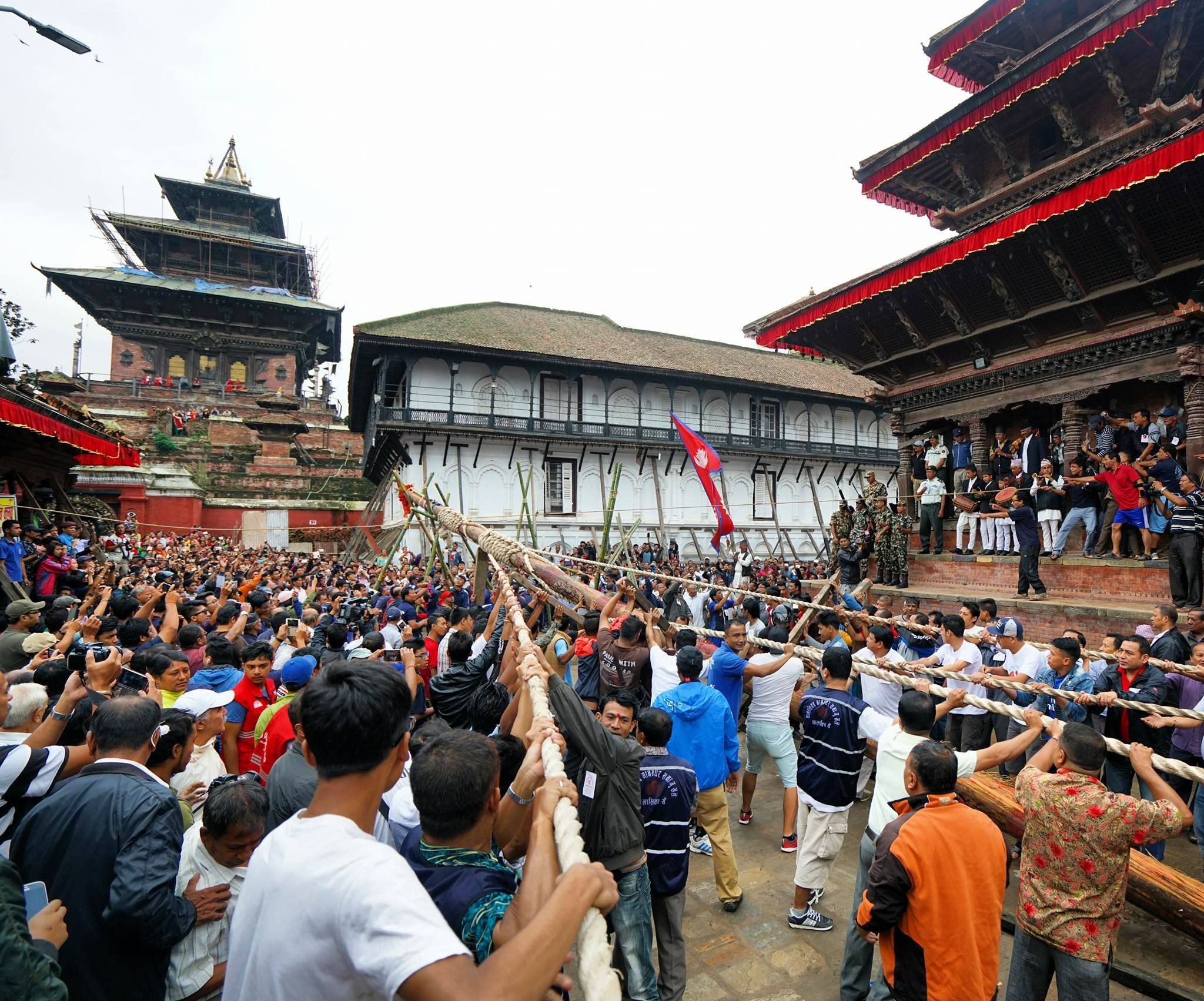
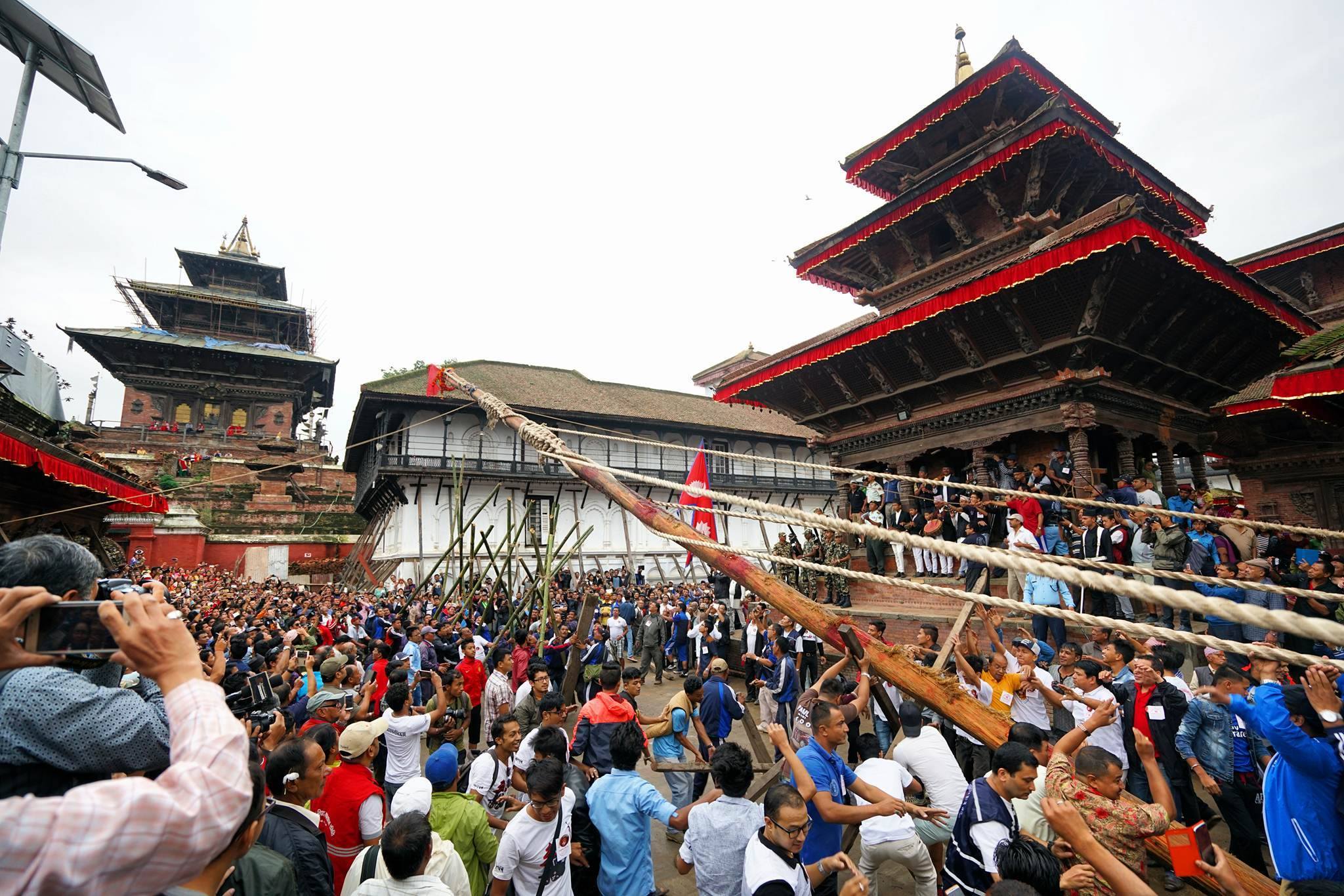
From the eight day of the Saait the 50-60-foot-long pole is erected at Kathmandu’s Durwar Square at an auspicious moment in the morning of the twelfth day of the bright half of Bhadra. (Van Den Hoek: 2014). A sacrificial pole from the Nala Forest, east of Bhaktapur is freshly acquired every year with the eight-day ritual of selecting, cutting the tree and its transmission into Kathmandu. . The erection of this pole indicates the official of Indra Jatra. Even though Michael Baltutis: 2008 goes in depth to show why the festival actually starts from the day people start the ritual of selection of the tree. (Which I am not yet so certain about- more on this later)
The South Asian festival of Indra, first mentioned in the Sanskrit epic Mahabharata some 2000 years ago. In ancient India it was celebrated as Indramaha where indradhwojarahan takes place; Indra’s banner(Indradhwoj) was created by Indra with the help of Vishnu during the churning of the primeval ocean of milk to defend the gods from attack of Asura. Raised on the ceremonial chariot of India the banner frightened the demons and gave victory to the god. (Toffin 1992) The relation between the Indradhwajarahan and yasim thanigu is yet to be defined clearly.
Upaku Wonigu:
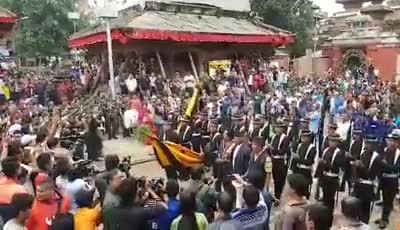
On the first evening of the Indrajatra, one’s family member who have died during the previous year is explicitly remembered, when citizens of Kathmandu observe Upaku Wonigu ‘walking the boundaries’ of the old city. In the procession of thousands of people walk through the city’s streets, walking the parameter of the old city in the clockwise direction, visiting the set of well decorated goddess shrines, often with local Jyapu drummers playing near their entrances and with large pile of samaybaji prominently displayed. Most participants carry lit incense, and many of the attending females place hundreds of clay lamps (Mata:) along the side of the path, marking their progress (Gutschow; 1982)
Pictures and video by Mohan Duwal from today's event at Hanuman Dhwakha.
#YenYaa #Indrajatra


September 12, 2016 at 11:46AM
Day 1546: Kumārī - The virgin manifestation of Taleju
Even though, the first known text recording Buddhist tantric worship, the Samvārodaya Tantra, is found to be composed in Nepal in 11th Century (Isabella Tree, 2012), the stories of Kumārī seems to only have taken place during the time of Jayaprakāśa Malla, the last Malla King of Kathmandu in 18th century.
STORY 1: The king, Jayaprakāśa Malla used to play dice with the royal goddess Taleju, the śakti of the realm, until his daughter intruded on them, which was against the agreement between the king and the goddess. There upon the goddess became angry and predicted in a dream that the Malla king’s reign would soon vanish. The king would never get the sight of the goddess again, instead a prepuberal girl of śakya caste from Buddhist clan would embody her. (Michael Allen, 1975)
STORY 2: In another story, also told by culture expert Satya Mohan Joshi, the king made sexual advances towards the goddess who, as a result, never appeared to him again.
In both cases the realm of the king was doomed but this downfall was temporarily averted by worshiping the human embodiment of Taleju as Kumārī and installing her rath yātrā(Chariot procession) as Kumārī Yatra.
Here onward we can see that Jayaprakāśa Malla’s kingdom of Kathmandu was conquered by Pṛthivī Nārāyaņa Śāha, after the Gurkha conquest in 1768 during Indra yātrā celebrations.
#IndraYaa
Image: Mohan Duwal

September 10, 2016 at 1:03PM
Day 1544 - X-factor
I have no doubt that this boy is born to be a superstar.
This video is on Facebook because Oneek wanted it to go on here.

September 7, 2016 at 1:03PM
Hee Haa - Need for speed!

September 5, 2016 at 1:04PM
Day 1539 - Girl Power:
The names of Aṣṭamāṭṛkās are in majority derived from those of the great gods of whom they represent the śakti, the essentially female power of action.
Aṣṭamāṭṛkās are from the Buddhist belief hence, the individual(puruṣa) does not exist that is why in contrast to Hindu conception, the circle of māṭṛkās is without a centre. However, in the predominantly Hindu town of Bhaktapur, the centre of the circle is automatically included as the ninth divinity who, moreover, encompasses the other divinities. The name of the group is not from eight to nine māṭṛkās as Navamāṭṛkās but is called Navadurgā. With the shift of terminology indicating a change of modality: Aṣṭamāṭṛkās are the subordinate to the distinct concept of Navadurgā.
In the City of Kathmandu both visions, Buddhist and Hindu exist side by side and together make up one scheme in which the royal goddess Taleju occupies the centre. The virgin manifestation of Taleju is called Kumāri, the living goddess.
#FemalePower #ReligiousHarmony #Kathmandu

September 3, 2016 at 1:05PM
Three lakhes at London Mela 2016

September 3, 2016 at 10:06AM
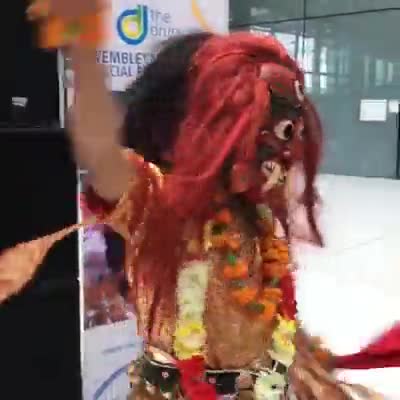
Day 1537: Lakhe Dance at London Mela 2016 with Binod Chipalu
September 2, 2016 at 1:10PM
Dy 1536: Aṣṭamāṭṛkā
There is eight māṭṛkās(mother goddesses) which surround each of the Malla kingdom of Nepal, situated at the points of compass. Offsprings and spouses of the māṭṛkās are more often than not disputable.
Each of the māṭṛkās surrounding these kingdoms is thought to embody a human quality, or rather a defect, which must be surmounted by the individual in search of liberation. Starting the north, the qualities of the eight māṭṛkās can be listed as: Rāga, dvesa, moha, ahaṃkāra, irsyā, darpa, māyā, and mada translated as desire, hate, enchantment, selfishness, envy, pride, illusion and intoxication.
Aṣṭamāṭṛkā mandala, as sketched by A.W. van Den Hoek(1992)
